
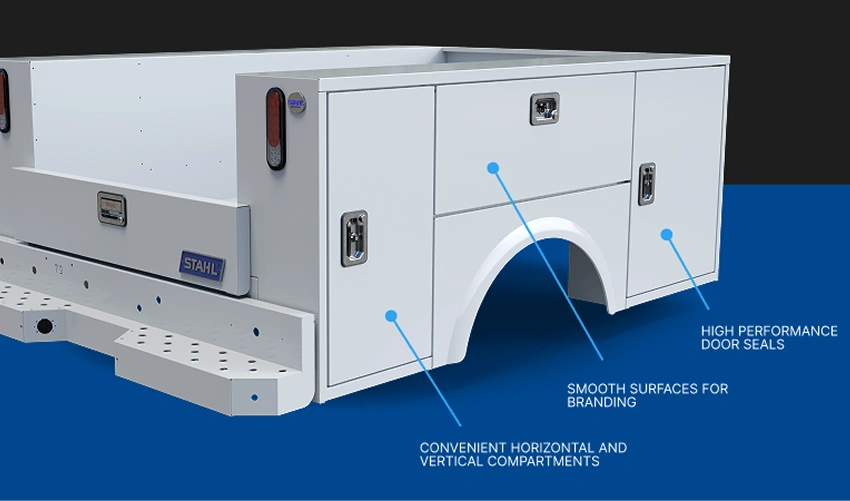
Product specifications, features, and price are all important when selecting a service truck body, but they only tell part of the story.
The truck body manufacturer you choose can also affect how quickly a truck is upfitted and put into service, how well the body holds up over time, and what kind of support you receive when you need it. Taking the time to evaluate the manufacturer behind the product can help you make a better long-term decision. Here are some of the most important factors to consider when comparing manufacturers.
Product Quality and Construction
A service body must be built to work. That means the construction methods and materials a truck body manufacturer uses should be among the first things you evaluate.
Look beyond appearance and consider how the body is designed to withstand daily use, weather, and demanding jobsite conditions. Pay particular attention to factors such as:
- Corrosion-resistant materials and finishes
- Door, hinge, and locking system durability
- Weather protection
- Structural reinforcement for demanding applications
These details affect how well a body performs over its service life. Corrosion resistance and durable components, for example, can help reduce repairs, downtime, and premature replacement.
Ask manufacturers how their bodies are constructed and why they use particular materials or methods. They should be able to clearly explain how those decisions contribute to durability and performance.
Product Range
Look at both the types of bodies truck body manufacturers offer and the configuration options available within those product lines.
For example, a manufacturer may offer open service bodies for everyday field work, enclosed bodies for additional protection and storage, crane-reinforced bodies for lifting applications, and other specialized configurations.
This is especially important for upfitters, dealerships, and fleets that need bodies for a range of applications. Instead of sourcing different types of bodies from several manufacturers, you may be able to rely on one manufacturer for more of your needs.
Working with the same manufacturer across multiple body types help establish greater consistency. Familiar construction, specifications, and installation requirements can simplify purchasing and upfitting while giving technicians greater familiarity with the bodies they maintain and repair.
Availability and Lead Times
Long or unpredictable lead times can create delays throughout the supply chain. Upfitters may have chassis waiting for bodies. Dealerships may struggle to maintain work-ready inventory. Fleets may have replacement or expansion plans held up while they wait for equipment.
Rather than simply asking about the current lead time, find out how consistently a manufacturer can meet that timeline and how availability varies across product lines.
Useful questions include:
- Which service bodies are regularly available?
- What are typical lead times for standard models?
- How do lead times change for configured or specialized bodies?
- How does the manufacturer communicate changes or delays?
- Can the manufacturer support larger or recurring orders?
Predictability can be just as valuable as speed. Knowing what to expect makes it easier to plan upfits, manage inventory, and give customers or internal teams realistic timelines.
The Upfitting Process
The relationship between the body and the chassis is another important consideration, particularly for upfitters and dealerships. Consistent designs, clear specifications, and thoughtful engineering can make installation more straightforward.
Ask about mounting requirements, body consistency, documentation, and technical support. If you regularly uplift similar vehicles, think about how easily the manufacturer’s bodies fit into a repeatable process.
A body that integrates smoothly into an established process can help reduce complications in the shop and get finished vehicles to customers sooner.
Service and Support
You may not think about service and support until you have an issue, but it’s important to evaluate the manufacturer relationship before you commit.
Pay attention to how responsive each company is during the buying process. Are questions answered promptly? Can you reach someone who understands the product? Does the company communicate clearly about orders and availability?
Then look beyond the initial purchase.
Find out what kind of support is available after the body is in service, including access to replacement parts, technical assistance, and warranty support. For fleets operating many units or upfitters maintaining long-term customer relationships, dependable support can play an important role in keeping trucks working.
A manufacturer shouldn’t disappear after the sale. Look for a company that’s prepared to support its products and customers for the long haul.
Experience and Track Record
Years in service can tell you sometime about a truck body manufacturer, but longevity alone shouldn’t make the decision.
Look at how the manufacturer has put that experience to work. Its engineering capabilities, product development, manufacturing processes, and understanding of the industries it serves can provide a better picture of what it brings to the relationship.
Consistency matters here, too. A manufacturer that can reliably support repeat orders and maintain established processes can be especially valuable to upfitters and fleets that don’t want every new truck to become a new learning experience.
It’s also worth looking at whether the company continues to evolve its products as truck platforms, technology, and customer needs change. Experience matters most when a manufacturer uses it keep getting better.
Look Beyond the Purchase Price
Price will always be part of a service body purchasing decision, but comparing quotes alone can provide an incomplete picture.
Consider what happens throughout the body’s service life. A lower initial price may be less attractive if the body requires more repairs, develops corrosion problems, or contributes to additional downtime. Inconsistent availability or difficult installations can create costs elsewhere in the operation as well.
Looking at these factors together can provide a more accurate picture of long-term value. For fleets in particular, durability, maintenance needs, downtime, installation requirements, and manufacturer support can all contribute to the total cost of ownership.
Questions to Ask a Truck Body Manufacturer
Before selecting a manufacturer, get the information you need to make a meaningful comparison. Consider asking:
- What materials and construction methods do you use?
- How do you protect your bodies against corrosion?
- What service body configurations are available?
- Which models are typically available, and what are your standard lead time?
- What customization or configuration options do you offer?
- What resources are available to support installation?
- How do you ensure consistency across repeat orders?
- What technical support is available?
- How are replacement parts handled?
- What warranty coverage do you provide?
These questions can help you evaluate both the service body you’re purchasing and the manufacturer you’ll rely on to support it.
Choose a Truck Body Manufacturer That Supports Your Operation
Choosing a truck body manufacturer is about more than comparing features on a spec sheet. You’re also choosing the company you’ll rely on for product availability, engineering, consistency, and support.
STAHL has been building work truck bodies since 1946. Today, we manufacture durable, American-made service bodies designed to perform in demanding applications while making it easier for upfitters, dealerships, and fleets to keep projects moving.
Our lineup includes open service bodies, enclosed service bodies, crane-reinforced service bodies, aerial bodies, and configurations designed for a range of work truck applications. With precision engineering, durable construction, reliable turnaround, and responsive support, STAHL is committed to being a manufacturing parter you can count on from the initial order to ongoing product support.
Ready to find the right service body for your application? Contact STAHL to learn more about our service bodies or connect with a distributor near you.